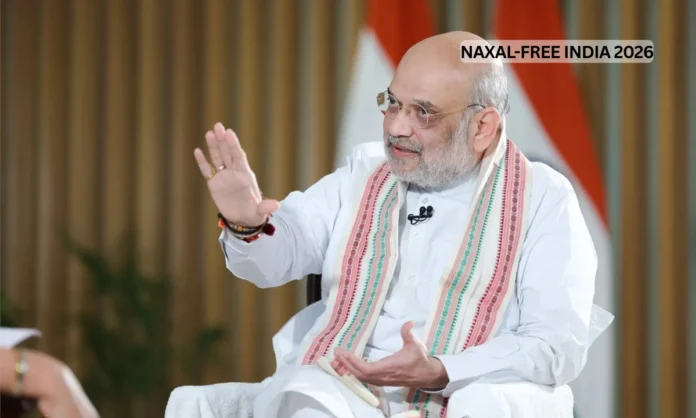

Union Home Minister Amit Shah has reaffirmed the government’s commitment to achieving a Naxal-free India by March 31, 2026, following a record 258 Maoist surrenders across Chhattisgarh and Maharashtra within just 48 hours — the largest mass surrender in India’s decades-long battle against Left Wing Extremism (LWE).
🔹 Historic Mass Surrender Marks Turning Point
Shah announced that two of the most violence-affected regions — Abujhmarh and North Bastar in Chhattisgarh — have now been officially declared Naxal-free, calling it a “historic milestone” in India’s internal security journey.
Out of the 258 who surrendered, 170 cadres laid down arms in Chhattisgarh on Thursday, following 27 the previous day and 61 in Maharashtra.
Among them were several top Maoist leaders:
- Satish alias T. Vasudeo Rao, carrying a ₹1 crore bounty
- Ranita (SZCM, Secretary, Maad DVC)
- Bhaskar (DVCM, PL-32)
“Those who surrender will be welcomed into the mainstream; those who continue violence will face decisive action. India will be completely Naxal-free by March 2026,” Shah asserted.
The surrendered cadres also handed over over three dozen sophisticated weapons, dealing a severe blow to the insurgency’s operational capabilities.
🔹 Rapid Decline in Naxal-Affected Districts
According to the Ministry of Home Affairs (MHA), the number of Left Wing Extremism-affected districts has fallen sharply from 126 in 2013 to just 18 in 2025, with only 3 districts — Bijapur, Sukma, and Narayanpur — still classified as “Most Affected.”
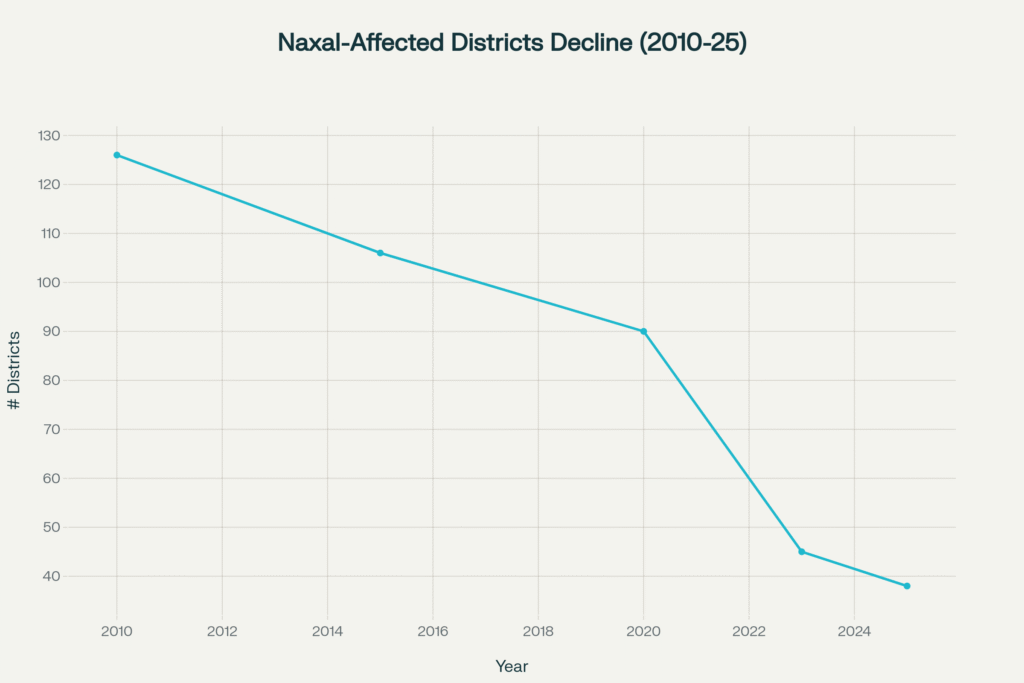
| Year | Most Affected Districts | Total LWE Districts | Status |
|---|---|---|---|
| 2013 | — | 126 | Baseline year |
| 2020 | — | 90 | Moderate reduction |
| 2024 | 6 | 18 | Major breakthrough |
| 2025 | 3 | 11 | Near completion |
The figures reflect unprecedented territorial recovery, particularly in Chhattisgarh — once considered the epicenter of Maoist influence.
🔹 The Comprehensive Strategy Behind Success
Shah credited the success to the government’s National Policy and Action Plan to tackle Left Wing Extremism — a multi-pronged strategy integrating security operations, development, and governance reforms.
Key Pillars of the Plan:
- Targeted, intelligence-driven counter-operations against Maoist leadership.
- Developmental push in newly cleared zones — roads, schools, healthcare, and digital access.
- Rehabilitation & surrender schemes encouraging reintegration of former Maoists.
- Financial chokehold on extremist networks through coordinated state-centre actions.
- People-centric policing, ensuring community cooperation and trust-building.
This approach, Shah said, ensures “the permanence of peace” — not merely the absence of conflict.
🔹 Progress in Numbers
Since 2024, operations across the Red Corridor have resulted in:
- 2,100 Naxal surrenders
- 1,785 arrests
- 477 eliminations in encounters
- 836 arrests and 1,639 surrenders in 2024 alone
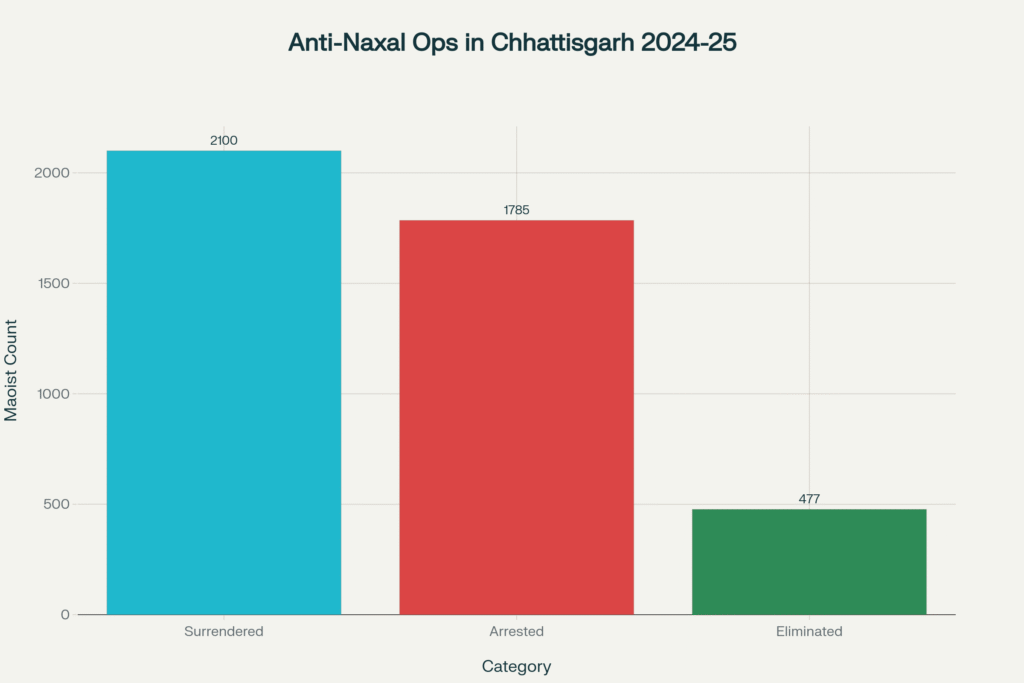
These outcomes, Shah noted, validate the dual strategy of “pressure and persuasion” — applying firm action while offering pathways to rehabilitation.
🔹 From Conflict Zones to Development Corridors
The complete clearing of Abujhmarh, once deemed the “nerve center” of Maoist operations, marks a symbolic and strategic victory. The region — previously inaccessible for decades — is now open for development projects, including connectivity, education, and livelihood programs.
Intelligence agencies report growing disillusionment among remaining cadres, with more high-level surrenders expected before the 2026 target.
“The transformation is visible — from fear zones to growth zones,” said an MHA official. “Our goal is not just military success, but lasting peace.”
🔹 Final Phase Toward a Naxal-Free India
As operations intensify in South Bastar, the government maintains confidence in achieving complete elimination of Left Wing Extremism within the set deadline.
Shah emphasized that the vision extends beyond counter-insurgency — toward ensuring permanent governance, justice, and opportunity in regions long marginalized by conflict.
“The surrender of 258 Maoists in 48 hours is not just a statistic — it is a signal that India is on the verge of ending one of its longest internal wars,” Shah declared.
With command structures dismantled, territories reclaimed, and community confidence growing, India appears closer than ever to realizing its goal of a completely Naxal-free nation by March 2026.
Here’s the visual explainer concept and full text breakdown for your infographic or carousel titled:
🧭 Timeline to a Naxal-Free India (2014–2026)
“From Red Zones to Growth Zones”
🟥 Title Frame
Timeline to a Naxal-Free India (2014–2026)
How India’s decade-long campaign is turning insurgent zones into development corridors.
📍 Source: Ministry of Home Affairs, Government of India
Visual: A map of India gradually transitioning from red to green across years, with areas like Bastar, Gadchiroli, and Abujhmarh marked.
🟧 2014–2017 — Building the Strategy
Phase: Foundation Years
- Government launches National Policy and Action Plan on LWE (2015).
- Focus on security + development: road connectivity, banking, and mobile networks.
- Districts affected by Naxal violence: 126
- Key Zones: Bastar (Chhattisgarh), Gadchiroli (Maharashtra), Latehar (Jharkhand), Malkangiri (Odisha)
🗣️ Amit Shah: “Our aim is not just to end violence but to ensure governance reaches every village.”
Visual: Policemen patrolling with villagers, roads being constructed through dense forests.
🟨 2018–2020 — Turning the Tide
Phase: Intelligence & Coordination
- Establishment of Unified Command Centres for inter-state coordination.
- Improved intelligence networks → major Maoist leadership losses.
- Affected districts reduced to 90.
- Civil programs launched: Skill training, Eklavya schools, Jan Dhan access.
📊 Impact: Violence incidents drop by 43% compared to 2013 baseline.
Visual: A side-by-side bar graph showing the drop in incidents and districts.
🟩 2021–2023 — The Big Push
Phase: Security + Surrender Strategy
- Government introduces rehabilitation and surrender policy for cadres.
- Targeted operations in Sukma, Bijapur, and Narayanpur.
- “Clear, Hold, Develop” approach implemented.
- Total surrenders cross 5,000 mark nationwide.
- LWE-affected districts: 18, “Most Affected” reduced to 6.
📸 Visual: A surrendered cadre handing over weapons to security forces.
🟦 2024–2025 — The Breakthrough
Phase: Historic Progress
- 258 Maoists surrender in 48 hours (Oct 2025).
- Abujhmarh & North Bastar declared Naxal-free.
- Total districts affected: only 11, “Most Affected”: 3.
- High-value targets eliminated — including Polit Bureau members and senior commanders.
🗣️ Amit Shah: “Abujhmarh, once the heart of Maoist terror, now beats with the sound of progress.”
Visual: A red pin over Abujhmarh turning green with “Naxal-Free” label.
🟪 2026 — The Goal Ahead
Phase: Final Mile to Freedom
🎯 Deadline: March 31, 2026
- Target: Complete elimination of Left Wing Extremism.
- Last major stronghold: South Bastar under final phase operations.
- Focus: Sustained development to prevent resurgence — roads, schools, governance, and local employment.
💬 Quote: “A Naxal-free India is not just about ending violence — it’s about ensuring justice, opportunity, and dignity for every citizen.” — Amit Shah
Visual: Symbolic image — soldiers hoisting the Indian flag in a village schoolyard.
🟫 At a Glance — India’s Progress (2013–2025)
| Indicator | 2013 | 2025 | Change |
|---|---|---|---|
| LWE-affected districts | 126 | 18 | ↓ 85% |
| “Most Affected” districts | 30+ | 3 | ↓ 90% |
| Annual violence incidents | 1,136 | 229 | ↓ 80% |
| Maoists surrendered/arrested | — | 3,885+ | Major decline |
| Civil infrastructure projects | — | 5,200+ | Rapid expansion |
Visual: Green progress bars with icons (districts, weapons, roads, people).
🌈 The Vision Beyond 2026
Headline: From Red to Green — The Next Chapter
- Empower local governance (Panchayati Raj)
- Boost education, health & digital inclusion
- Promote tourism & investment in reclaimed regions
- Ensure peace remains permanent through opportunity
🌿 “A Naxal-free India is a prosperous India.”
Visual: Children with books, solar lights in villages, development imagery replacing conflict zones.
Amit Shah Confirms March 2026 Deadline for Naxal-Free India After Record 258 Maoist Surrenders, Naxal-free India, Amit Shah Naxal surrender, Left Wing Extremism, Chhattisgarh Maoist surrender, 2026 deadline
Union Home Minister Amit Shah announces 258 Maoist surrenders across Chhattisgarh and Maharashtra, declares Abujhmarh and North Bastar Naxal-free, and reaffirms the March 2026 goal for a Naxal-free India.