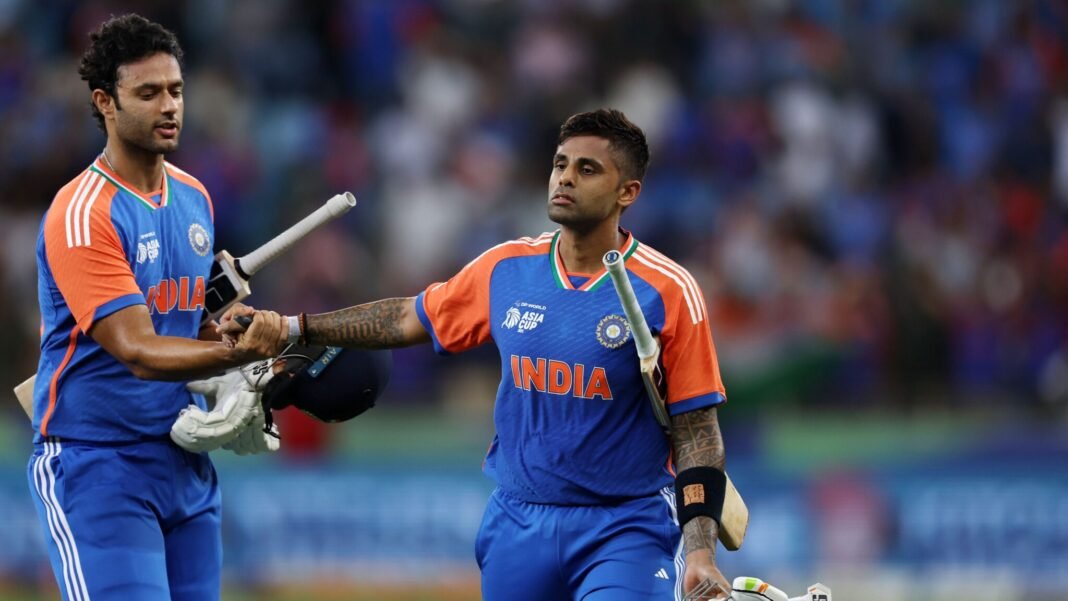

The India–Pakistan Asia Cup 2025 encounter was as fierce off the field as it was on it. Following India’s commanding seven-wicket victory over Pakistan at the Dubai International Cricket Stadium, a post-match controversy erupted when the Indian players chose to skip the customary handshake with their Pakistani counterparts — a gesture usually seen as the ultimate symbol of sportsmanship.
What began as a thrilling cricket match soon evolved into a debate about sports, politics, and national sentiment, sparking reactions across both nations.
⚡ The Match That Set the Stage
The much-anticipated Asia Cup clash drew global attention, as always when India and Pakistan share a pitch. Batting first, Pakistan struggled to build momentum, managing a total of 127/9. India’s bowlers, led by Kuldeep Yadav with three wickets, delivered a disciplined and clinical performance.
In reply, India’s chase was confident and measured. Captain Suryakumar Yadav anchored the innings with an unbeaten 47, guiding his team to victory with several overs to spare. The win strengthened India’s campaign — but the real storm began after the final ball was bowled.
As Pakistan’s players lined up for the traditional handshake, the Indian team walked directly toward the dressing room. Cameras caught Pakistan captain Salman Ali Agha waiting on the field, visibly disappointed. He later skipped the post-match presentation, citing “discomfort” with the abrupt end to proceedings.
🗣️ Suryakumar Yadav Breaks Silence
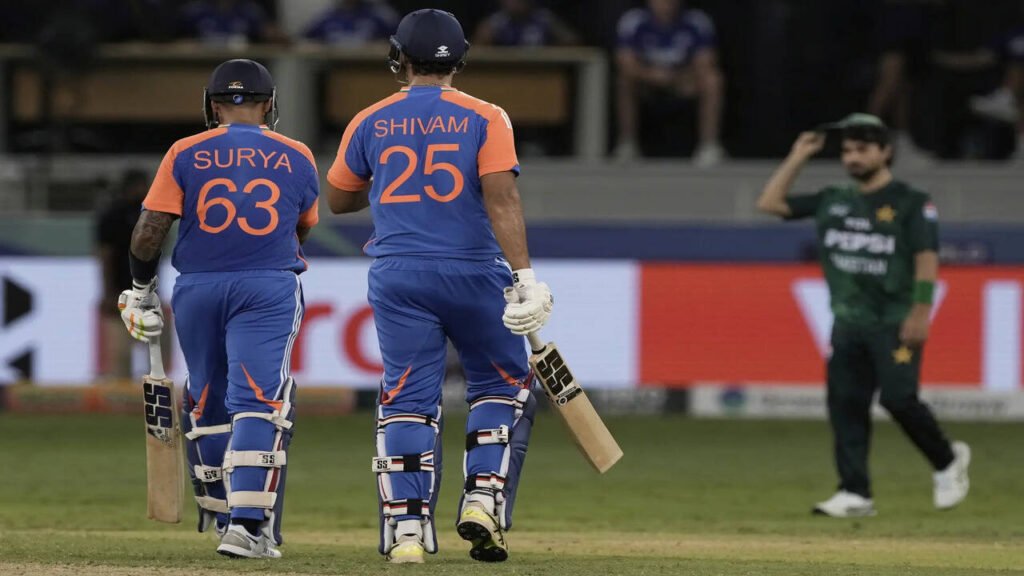
Addressing the growing controversy, Indian captain Suryakumar Yadav offered a candid explanation. He revealed that the team’s decision was not spontaneous, but taken in accordance with directives from the Indian government and the Board of Control for Cricket in India (BCCI).
“This wasn’t a personal decision or about disrespect. It was a moment to stand with our people,” Suryakumar said during the post-match briefing.
“The team wanted to express solidarity with the victims of the recent terror attack in Pahalgam, Jammu & Kashmir, and to honour the sacrifices of those serving in Operation Sindoor.”
He further noted that while sportsmanship is vital, “some things in life go beyond the spirit of the game,” alluding to national sentiment taking precedence in times of grief and conflict.
🇮🇳 A Gesture of Solidarity
According to team sources, the players were briefed before the match about maintaining “measured conduct” in light of recent national events. The choice to forgo the handshake was intended as a silent tribute — a symbolic moment of respect toward the victims and armed forces rather than an act of hostility toward Pakistan.
The BCCI has reportedly backed Suryakumar’s stance, reiterating that players acted in line with guidance reflecting the nation’s emotional climate.
🌍 Mixed Global Reactions
The incident immediately polarized fans and analysts across the subcontinent.
In Pakistan, cricket officials described the move as “disappointing” and “contrary to the game’s spirit.” Social media buzzed with criticism, calling it a break from the sportsmanship that cricket embodies.
Meanwhile, in India, public sentiment largely supported the team’s decision. Hashtags like #WithOurForces and #NationFirst trended across platforms, with many lauding the players for “standing with the nation above all.”
Some neutral cricketing voices, however, cautioned against mixing politics and sport, arguing that cricket should serve as a bridge of peace, not a reflection of conflict.
📖 Historical Context: When Cricket Mirrors Politics
The handshake controversy is not without precedent.
India and Pakistan’s cricketing relationship has always reflected broader political realities. Since their first bilateral series in 1952, matches between the two nations have symbolized far more than just sporting rivalry — they’ve often been seen as diplomatic barometers.
Periods of political tension have frequently disrupted cricketing ties, with tours cancelled or suspended. Even on-field gestures — from post-match celebrations to anthem protocols — have historically carried political undertones.
🏏 Sportsmanship vs. Sentiment
Cricket, often called “the gentleman’s game,” prizes gestures of respect: the handshake, applause for the opponent, and camaraderie beyond competition. The absence of a handshake in this case reignited debate on whether national sentiment can justify departures from tradition.
Supporters argue that moments of national mourning or conflict warrant sensitive responses — even in sport. Critics, however, believe such symbolic gestures risk eroding the global image of cricket as a unifying force.
“Sport has always had the power to heal, to bridge divides,” wrote one former cricketer on X (Twitter).
“But it also carries the responsibility of reflecting the mood of its people.”
🔍 Broader Implications
The incident underscores the growing intersection of politics and sport in the modern era. Every move by athletes — especially in matches between politically charged nations — is amplified by 24/7 media coverage and social media discourse.
Analysts warn that such controversies, while understandable, could affect future India–Pakistan encounters, both diplomatically and within ICC tournaments.
🚀 Moving Forward
As the Asia Cup 2025 progresses, both teams are likely to avoid further escalation, focusing instead on their cricketing objectives. The BCCI has reportedly reached out to tournament officials to clarify India’s stance, emphasizing that the decision stemmed from national sentiment, not disregard for the opposing team.
For Suryakumar Yadav, the moment reflects a leader balancing emotion and duty — one that extends beyond the boundary rope.
“We play for our country. Every run, every decision, every silence — it all carries meaning,” he said.
🏁 Conclusion
The India–Pakistan Asia Cup handshake controversy is more than a post-match anomaly — it’s a reflection of how cricket in the subcontinent transcends sport, echoing national pride, grief, and politics all at once.
While opinions remain divided, one thing is certain: this incident will be remembered as a defining chapter in the 2025 Asia Cup — a reminder that in matches between India and Pakistan, every gesture tells a story.
Suryakumar Yadav Explains Why India Skipped Handshakes with Pakistan After Asia Cup Win
Following India’s Asia Cup win over Pakistan, captain Suryakumar Yadav revealed the team skipped the post-match handshake as a mark of solidarity with terror attack victims in Jammu & Kashmir.